Well rested by a good night’s sleep half of our group starts the ascent to Lomisa Monastery in the region of Mskheta, which has been presented to us as a very special place by a friendly young lady who also made it possible for us to get into contact with the local monks due to her proficient translation skills. The monks promptly gave us a bottle of homegrown wine and we were pretty ashamed that in the chaos of our leaving Tbilisi we plainly forgot to take any presents for potential hosts.
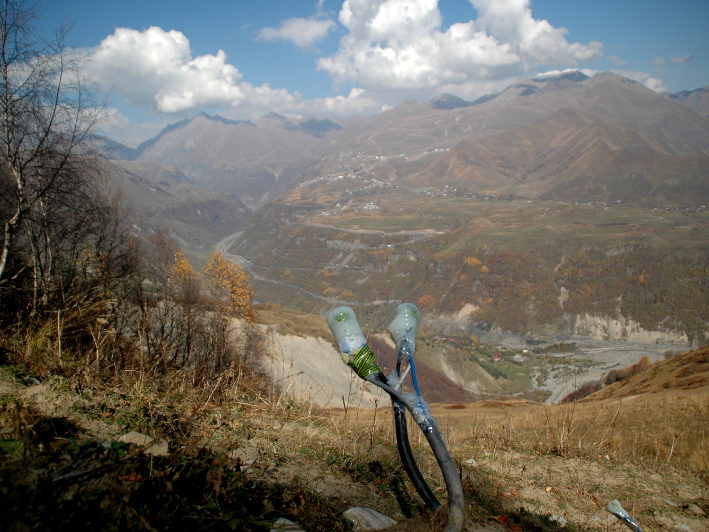
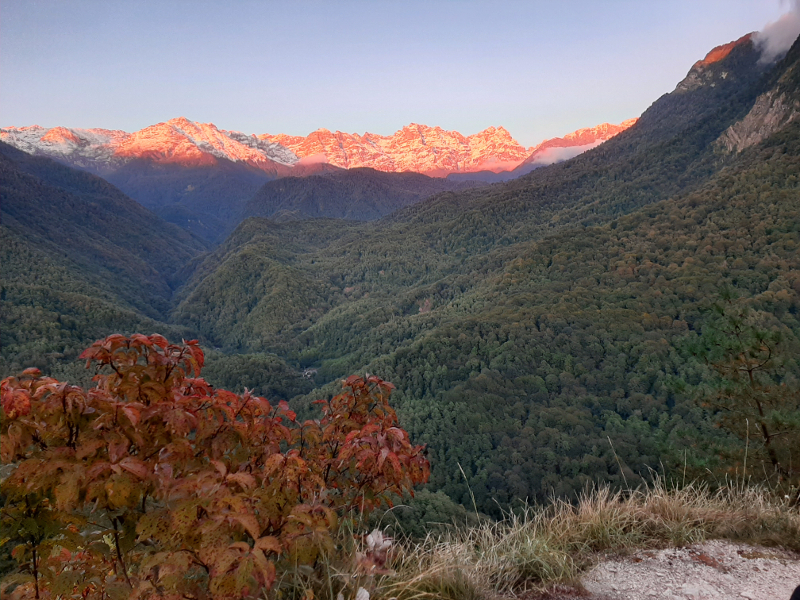
Well, off we go. We start ascent into a glorious autumn morning. For the first 300 m of altitude we follow a beautiful footpath through heaps of rustling foliage and reach our first viewing point shortly above the tree line. It consists of a small altar and cross and presents a stunning view to the north as well as a place of praying for pilgrims.
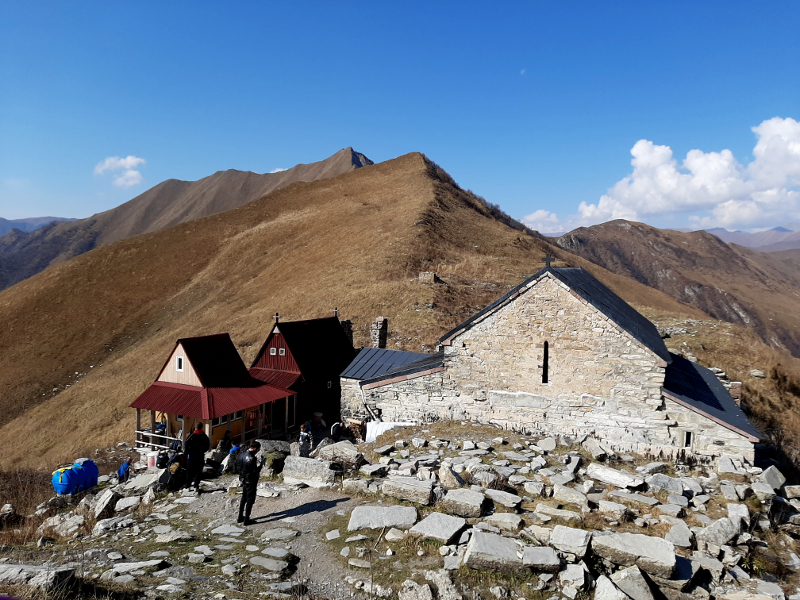
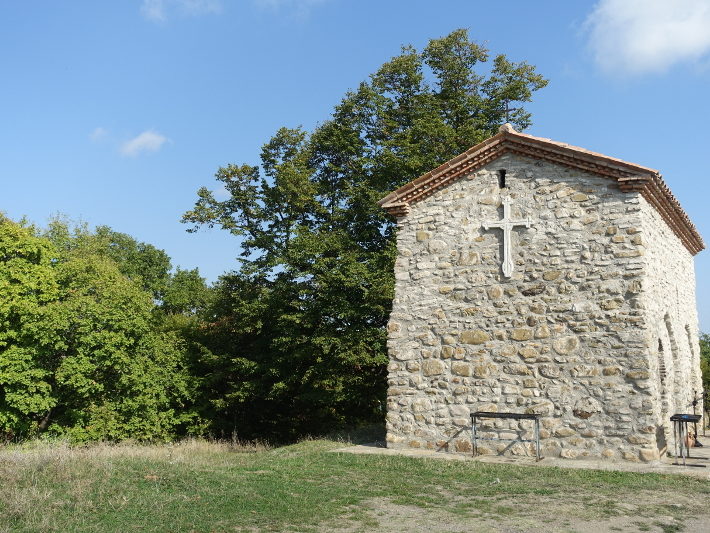
We continue up to the monastery. Three monks live here permanently although they regularly descend into the village to top up their supplies. It seems to be a tradition for the omnipresent pilgrims to take a piece of firewood up the mountain as a gift for the monks.
Despite us being able to enjoy the way up as well as the monastery itself without the encounter of too many others, Lomisa seems to be quite an important subsidiary of the Orthodox Church as we discover when telling our friends about our march and exploring further on the internet. Another thing we did not realize in advance is the fact, that up at the monastery we are situated exactly on the controversial border to South Ossetia.
The place itself is simply peaceful and emanates a great dignity. The little church is really tight and paltry but made up with so many Icons brought up here by hikers and pilgrims. Even if instead of doing just over 400 m in altitude we ended up doing more than 700 it was definitely worth it. The charisma of this place is magical.
Wir haben Besuch aus Deutschland! Für zwei Wochen besucht uns meine Schwiegwerfamilie aus Nordrhein-Westphalen. Am Ende der ersten Woche machen wir uns mit zwei Wohnmobilen auf den Weg nach Stepanzminda in der Region Kazbegi. Unter grossem Chaos bestücken wir unseres sowie das grössere der beiden Wohnmobile von Georgia Insight mit allen Notwendigkeiten und machen uns gegen 15:00 auf den Weg nach Norden. Stepanzminda erreichen wir leider erst im Dunkeln und unseren Stellplatz finden wir mitten im Ort, da wo früher angeblich mal ein Zeltplatz war. Jetzt ist dort ein unbefestiger aber sehr hübscher Wald-Park, der sich ziemlich gut eignet, eine Nacht im WoMo zu verbringen.
Unser heutiges Ziel ist der Besuch der kleinen Kirche, die man auf dem ersten Bild unten sieht. Da es bis dorthin immerhin gut 400 Höhenmeter und etwa 4 km sind, ist die Kirche wohl nicht so ganz klein. Alle, die wir nicht gerade fusskrank oder lustlos sind, machen wir uns also auf den Weg nach oben, während die Schmerzgeplagten mit dem Taxi fahren, um uns dort zu erwarten. Dieser Plan geht leider nicht auf, da der Taxifahrer der Ansicht ist, dass 10 min Kirchbesichtigung reichen und man dann besser wieder runterfährt, damit man die nächsten Gäste abzocken kann. Schade.
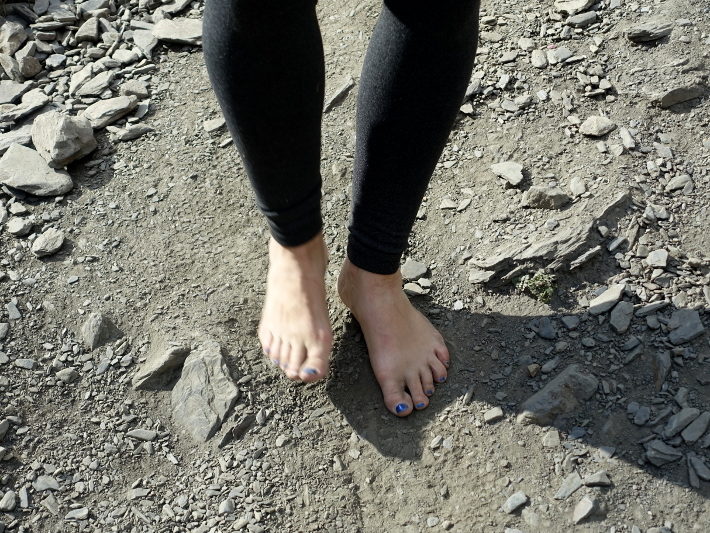
Uns bleibt leider auch nur begrenzt Zeit die wirklich schöne Kirchenanlage zu erforschen und die sensationelle Aussicht zu geniessen bis uns ein scheinbar dramatischer Wetterumschwung in Richtung des Kazbek zwingt, ebenfalls den Abstieg anzutreten. Da Lotte ungeeignetes Schuhwerk trägt, wage ich mich barfuss auf den Abstieg und bin wirklich erstaunt und begeistert, was ein Paar Füsse so alles aushält.
Unten angekommen werden die WoMos startklar gemacht und wir treten die Heimreise an. Einmal mehr werden wir diese mit einer weiteren Nacht in der Wildnis verlängern und einmal nachsehen, wo in Georgien schöne Pätze für eine Nacht im Camper zu finden sind. Das ist nämlich einfach das schönste am Reisen mit dem Wohnmobil: Wo es schön ist, kann man hier einfach bleiben. Ist Zivilisation drumherum, kommt man immer wieder in Kontak, weil die Mobile doch eher noch eine Ausnahme darstellen und wenn nicht, umgibt einen herrliche Dunkelheit und Stille.
Today is going to be a special day. Its is the last day of harvest in Georgia and we are invited to take part in this celebration with Gia’s family in Jimiti by helping to pick the last of this years grapes and joining in the feast afterwards.
At 8:30 a.m. we leave Tbilisi and turn of the main road direktly into the winefields afte about 80 km.
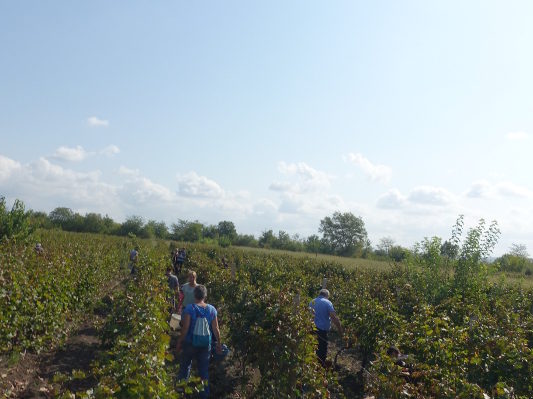
Grape picking is just the same as in Fischingen a few years ago. A jumble of people meet with buckets, kitchen knives and garden scissors and with a lot of laughter and sticky hands we cut those gorgeous grapes off the vine. The only difference: it is warm, dry and flat in Georgia while it used to be muddy, cool and steep in Fischingen…
Sweet and thick and warm from the sun…
Having worked for half an hour we are invited to a first picnic. We are presented with this wonderful traditionally baked bread, eggs, cheese, sausages, tomatoes, burgers, beans and fried potatoes. Additionally Chacha (a grape schnaps) and Water. It is tradition here that you seem to present a little blessing or thanks before you drink any alcohol.
Being so well cared for the next two hours of work fly by easily and we return to Gia’s parent’s farm. The electrical grape shredder has a little difficulties starting, so most of the party leave for a walk to the nearby St. George’s church and a small chapel on the surrounding hills to enjoy the look over the Kachetian plain.
In the early days the church was the center of the village until the inhabitants were made to move down the hill more or less willingly. Now the meadow of old Jimiti is dotted with small huts the history of which is as follows: The wine cellar was the heart of each family’s house as well as their wine being a kind of calling card. Traditionally here the wine is stored in socalled Qvevris (earthen amphorae), which for keeping moisture and temperature were buried in the earth. One of each family’s Qvevri was holy and this holy one was left where the family’s house was once standing. Marked and closed they were just dots on the landscape until more and more people gave them small new homes and started caring for them again on a more regular basis. Supposedly some of them are even filled again and if you find wine, you can take some.
Back on the farm about two hours later a veritable feast aweits us. Feasting is another good place to disgrace oneself. In Georgia it works like this: once you reach the usually brimming table you sit down and eat. No waiting or talking – just eat. You can also dring water. Then the wine is served and here many mistakes are possible. Here are some instructions:
1. A glass of wine is never completely filled nor completely empty – empty is reached by halving the contents.
2. If you drink wine this is accompanied by a blessing or toast reaching from thanking for a rich harvest, then friends, then family, then parent (living and dead) and can easily take a few minutes to be uttered.
3. When you heard “gaumarjos” you lift your glass and empty it in one go and it is refilled immediately. If you want to keep your senses, just leave the glass on the table. That’s alright but only sipping small amounts is not.
Luckily the glasses only contain about 0.1 l.
It was wonderful thank you.
This traditionally pressed wine tastes completely different to our normal clear and light white wines. Ulrich explains the taste very adequately by saying: Like Vinsanto but without the sweetness. I wonder whether it tastes as nice once we are at home. But we will surely bring a few bottles.
By 6:00 p.m. the premises are emptying. Having been warned to drive with doubled vigilance because of many such feasts in the region we depart for Tbilisi. IT turns out the warning was well due as there are quite some situations with cars not exactly staying in their lanes bu Ulrich takes us easily through the danger zone and we arrive quite safely. Driving in Georgia is hell but driving here with drunks is much much worse.
Already our last day is upon us. Well, nearly, as we will do the return journey in two days, too.
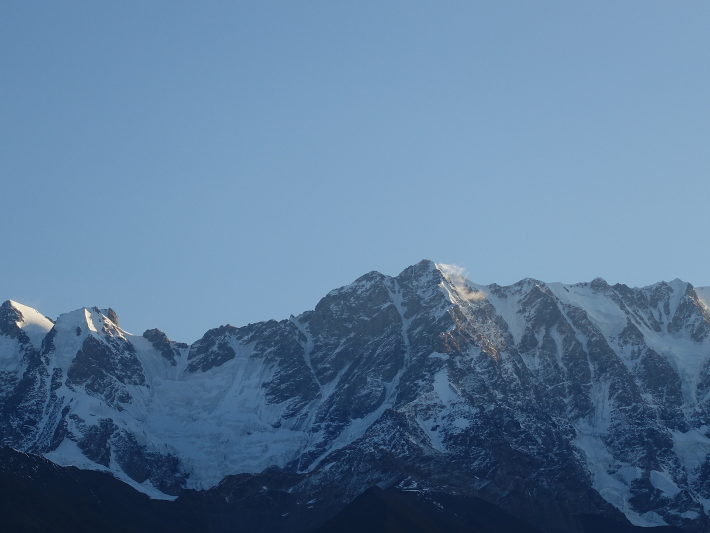
The view into the mountains reveals how cold it really was yesterday and the during the night. I am sure Ushguli is all snowy.
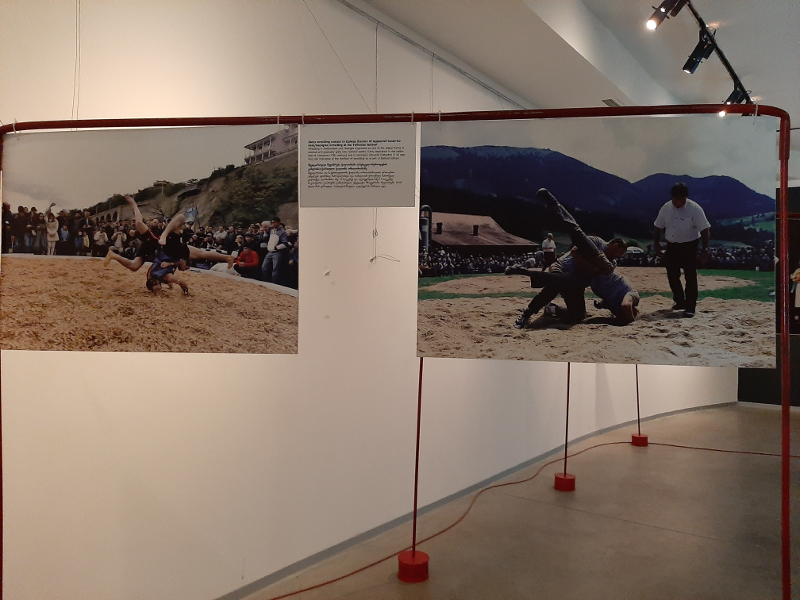
In the morning we take our time to finally visit the Svaneti Museum, while Ulrich is taking care of his lectures. Funnily enough just now there is an exhibition in this really quite interesting historic museum comparing Switzerland with Georgia. The similarities are quite astounding…
Around noon we leave Mestia. We would like to find some places on our way back, where one could stay overnight with a camper. There are a few parking bays on the way but none of them compares favorably to our place from our inward journey, so we just go there again. The view is simply too beautiful.
During the night rain set in and it is really cold and awful outside. Again we are treated to a pleasant breakfast in the restaurant, while the host’s family start preparing supper for a rather big group which is expected for tonight.
Ushguli in the rain
At 10 am Goga returns to take us back to Mestia on an even bumpier road. Originally the further plan of the day was to explore the town and visit a few museums. Sadly it is so cold and uncomfortable outside, that we cuddle up in Bekos Garden Inn’s guestroom and only leave the warmth in late afternoon to visit the Svanetian Museum, where I promptly discover that I forgot my purse in the camper…
On our way out we booked a table at Lushnu Quor Restaurant which turned out to be a brilliant idea of Marianna’s who suggested this restaurant to us. We devour a great Georgian supper in a beautiful atmosphere.
Good morning! After weeks the night was really dark and quiet and we get up for breakfast at 8:00. Here Ulrich admits to being up since 6:30 and having watched the sunrise – I am jealous. There were times when he asked me out for such occasions.
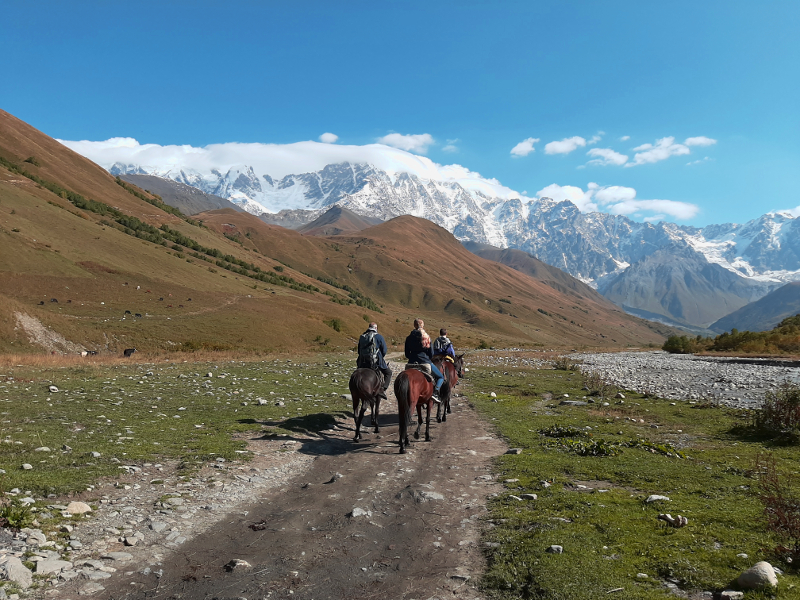
Well, it doesn’t matter. Breakfast is rich and gorgeous and today we are up to something special: at 10 am a guide and 5 horses will wait for us to ride into the valley to the Shkhara glacier. This means cutting a 9 km walk down into 6 km of riding and a walk to the glacier’s entrance.
Watching our girls from behind one could really get the impression, that they actually learned something during their three riding camps years ago. Also my two riding lessons with my sister turn out to have been helpful. At least I know to put my feet near the horse’s belly… But poor Ulrich is shaken badly.
We are lucky though. The horses are very patient and obviously used to incompetent riders, so they mostly walk and surely know perfectly well where they are supposed to go. The only difficulty arises when my right stirrup decides to go. Instead of being fastened with a belt buckle, their length is determined with about 7 knots, the last of which is just going. So no more chance in clinging to the horse but just trying to keep the stirrup from falling off my foot.
Anyway the idea of riding is very good. Walking along the valley would have been rather dull, while this way we have a beautiful experience and still the possibility of a nice walk to the glacier’s gate. Plus during the afternoon the weather deteriorates and we are quite happy to be warmed from below.
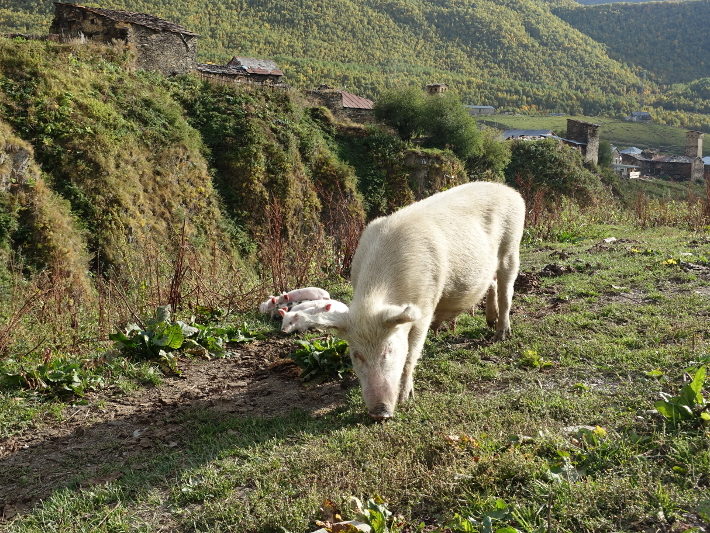
Back in the hotel we take a short break. Somehow I fell rather bowlegged and walking is really uncomfortable. Then Lotte and I go to the “cinema”. The daily movie is called “DEDE”, a georgian production in and around Ushguli. We are presented with a predictable Romeo-and-Juliet-story but the pictures of the landscape and the portraits of the actors are photographically very beautiful. Also the film shows many of the old traditions which are still prevalent in the region. DEDE was produced two yeas ago and until today you meet parts of the cast in the village milking cows, chasing pigs and baking Katchapuri.
Visiting the cinema turns out to be a special experience particularly because it is situated in the basement of one of the watchtowers, the seats are made up from three rows of terraced wooden planks made comfortable with a bunch of old sofa cushions, the presentation comes from an old notebook with a projector and the sound squawks from a set of miniature loudspeakers which are completely overstrained. We are shivering with cold and enjoying ourselves perfectly. And just bear in mind: For two years this movie is run five times a day and keeps a family going – now that’s sustainability! And just to tell you: if ever I come back to Ushguli I will go there again and I will make everyone to join me.
When we later return to the hotel it is cold and uncomfortable outside – looks like we enjoyed one of the last warm days of this year. Thank you Ushguli!
Today we are going up to Ushguli in two steps. Ushguli is supposed to be the highest permanently inhabited village of Georgia/ Europe. Although this honour is shared with the village of Juf in Grisons/ Switzerland.
First we battle our way up to Mestia for about 120 km on a road of rather mixed quality. Here Goga awaits us to take us to Ushguli with his Jeep, while we can leave the camper in his garden. The journey from Mestia to Ushguli is about 50 km. For the first 35 km we agree on probably being able to have done it in the camper, too. But then we hit the last 15 km and have to admit, that within the first 10 m of the last 15 km, the camper would undoubtedly have broken down – so good idea taking a taxi…
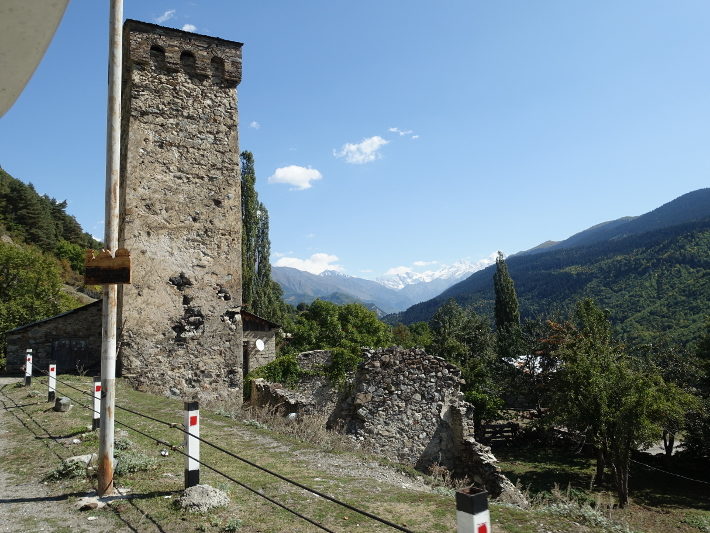
Up in Ushguli we are dropped off at the Guesthouse Ushguli Maspindzeli and move into two very pretty rooms with ensuite bathrooms and cozy beds. At the moment there is no electricity available but this seems to be the case all over Ushguli and nobody seems to really care.Before dinner there is time for a little walk around the village. Ushguli is an extremely pretty village. Traditionally every family has their own watchtowe. Originally they were built to defend the village and as a place of refuge if attacked. Since 1996 those towers are part of the UNESCO world heritage and give the village a rather archaic and forbidding appearance.
Besides the tourists there live about 70 families permanently in Ushguli. Mainly they derive their income from tourism but there is also a little bit of livestock and a minimum of dairy farming.
The most particular thing about tourism here is that you are somehow treated like extended family. The hotels seem to be redecorated farms, the hosts long established inhabitants. The milk for breakfast is milked just in front of the house and during the day women from the neighbourhood meet to prepare the vegetables for dinner, while the male host cuts half a shin of beef into cubes for the soup. All this takes place in the restaurant. Hospitality does not take place behind doors but is plainly visible to the guests. Swiss gastronomy hygienists would have a field day.
As the schoolcamp for our children has been cancelled at the last moment and the start of Ulrich’s term postponed, we decide to take another few days off and discover a little more of Georgia by travelling to Svanetia with the camper.
Moving back home into the van last night, we leave early today to travel westwards. Happily we take on the suggestions of Katrin and Georgia Insight and develop this schedule:
18.09.2019 journey to Zugdidi, or a little further 19.09.2019 journey to Mestia and taxi to Ushguli 20.09.2019 Ushguli 21.09.2019 Taxi Ushguli – Mestia, overnight stay in Bekos Garden Inn, Mestia 22.09.2019 either going on or starting to return to Tbilisi 23.09.2019 return to Tbilisi
The journey is easy and we reach a point about 40 km behind Zugdidi, where we are already within the main valley of the Svanetian region. We find a beautiful place to stay overnight just beside the road in a parking bay overlooking the most beautiful valley. Three of the omnipresent stray dogs keep us company during the night and only occasionally we can hear a car passing.